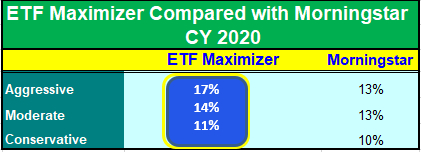
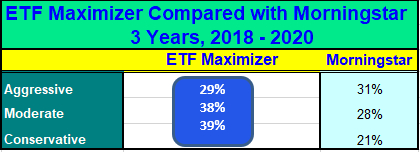
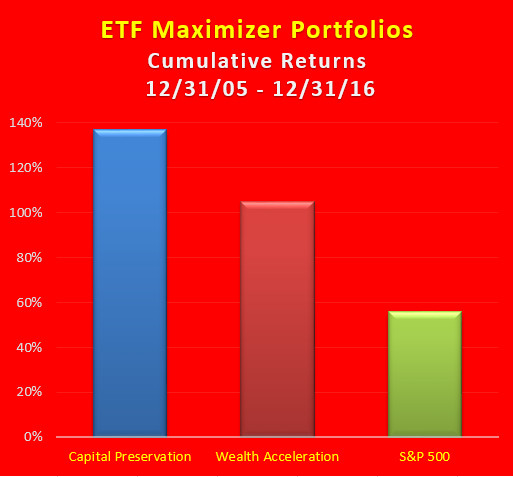
ETF Maximizer was developed specifically for managing accounts with Exchange Traded Funds (ETF's).
Our ETF Maximizer newsletter was one of the very few on the planet with positive returns for 2008. The ETF Traveler and Trader Systems beat the S&P 500 by over 43% and 39% respectively in 2008 and outperformed over 99.7% of the 7,188 U.S. equity mutual fund managers that we track!
Since 2008, ETF Maximizer recommendations have continued to generate positive returns but underperformed the major market indexes in 2009 and 2010. This under-performance along with some prompting by a perspective business partner to develop a better system to invest in Exchange Traded Funds caused us to re-examine the process we use to select funds with in early 2010. That work continued throughout 2010 and resulted in a huge and important change in the process and logic of the software model used to select funds. This is not a trivial or small difference but a major change in the logic of the screening the software model does to generate fund recommendations. And although some of those changes were implemented during the course of 2010, the full effect of all of these changes on portfolio performance was not fully implemented until the last several months of 2010. As a note to other system developers- there was no optimization done in any of this work.
The tables and charts below show how the new software models would have affected fund selections over the past 5 year period from January of 2006 through the end of December 2010. The results are so significant that we are changing the name of each portfolio featured in the newsletter from “Traveler” and “Trader” to “Capital Preservation" and “Wealth Acceleration” to more accurately reflect the performance you can expect to see following each portfolio.
We call the first portfolio Capital Preservation because so many folks are parking savings in a money market today and not earning any interest on it. Our primary focus with this portfolio is preservation and growth of capital, minimizing risk and draw downs so that users can sleep at night, live with the returns and not experience the wide equity swings that are characteristic of so many Exchange Traded Fund selection processes.
The tested Standard Deviation of this portfolios monthly return over the 5 year period from January 2006 through December of 2010 was 49% of the S&P 500’s Standard Deviation over the same period, while delivering a compounded annual return of 10.5% vs. a compounded annual return of -0.3% over that period for the S&P 500 Index. The portfolio experienced 19 losing months during the 60 month period, with an average monthly loss of 1.5% when it finished lower. The largest single monthly loss was 5.97% in 2010.
The table below shows the annual year-to-date returns of the Capital Preservation portfolio over the past 5 years. The annual returns are highlighted in cyan. For example the return for the first year of 2006 is 13.19% and the second year of 2007 is 17.09% and so on. Each chart on the right hand side shows that particular years returns in blue and the S&P 500 Index in red in chart form.
The next table shows monthly returns of the Capital Preservation portfolio over the same time period. For example, the first row of data labeled January, 2006 shows the monthly returns of both the fund selections generated by the process during the month of January 2006 along with the S&P 500 index during that month. The next row labeled February, 2006 shows the monthly performance of both the Capital Preservation portfolio and the S&P 500 during the following month of February 2006 and so on. The rows colored cyan show the return for the month of December each year. A close study of the monthly returns at the end of 2008 shows how well the model adapted to the changes in the market and continued to produce monthly gains while the S&P 500 crashed.

Next, is an examination of the Standard Deviation of monthly returns for the Capital Preservation portfolio vs. those of the S&P 500 over the 5 year period, along with the sum of the monthly returns over the 5 year period vs. the sum of the gains for the S&P 500 over that same 5 year period. The Sharpe ratio reflects the sum total of the monthly returns divided by the Standard Deviation of monthly returns over the same period of time. Please note how the Standard Deviation (which is a way to measure portfolio risk or volatility) of the Capital Preservation Portfolio is roughly 51% less than the volatility of the S&P 500 index over that same period of time. Or looking at it from another perspective the Capital Preservation portfolio only experienced 49% of the volatility of the S&P 500 Index on a month by month basis over this 5 year period. Finally, the compounded annual returns for both the Capital Preservation and the S&P 500 are shown for the 5 year period.

Finally, here’s a big picture chart of how the Capital Preservation Portfolio has done over the past 5 year period vs. the S&P 500 Index.

The second portfolio is called Wealth Acceleration. Our work has shown that this approach generally out performs the returns generated by the S&P 500 index by a wide margin over most market cycles.
Mark Hulbert is a self anointed monitor of financial newsletter performance. He ranks and describes a number of financial newsletter’s performance in his newsletter the Hulbert Financial Digest. Although Mr. Hulbert only ranks a small sub-set of all of the newsletters published it is instructive to compare the performance of the newsletter that he has anointed as the best in the country for the past several years – The Navigator Newsletters published by Mark Grimaldi, with the returns shown below.
Please examine the returns for The Navigator Newsletters Exchange Traded Fund portfolio at the following link with those shown in the tables below:
http://www.navigatornewsletters.com/results.php
It’s clear that the returns for the Wealth Acceleration portfolio outperforms Mark Grimaldi’s Exchange Traded Fund portfolio by a wide margin in terms of both risk and reward.
The table and accompanying charts below show the annual year-to-date returns of the Wealth Preservation portfolio over the past 5 years. The annual returns are highlighted in cyan. For example the return for the first year of 2006 is 29.08% and the second year of 2007 is 25.21% and so on. Each chart on the right hand side shows that years returns in chart form.

The next table shows monthly returns of the Wealth Acceleration model over the same time period. For example, the first row of data labeled 12/31/2005 shows the monthly returns of both the fund selections generated by the process during the month of January 2006 along with the S&P 500 index during that month. That performance runs through the next date of 1/31/2006. Then, the next row labeled 1/31/2006 shows the monthly performance of both the Wealth Acceleration portfolio and the S&P 500 during the following month of February 2006 and so on. The rows colored cyan show the return for the month of December each year. A close study of the monthly returns at the end of 2008 shows how well the model adapted to the changes in the market and continued to produce monthly gains while the S&P 500 crashed.

Next is an examination of the Standard Deviation of monthly returns for the Wealth Acceleration portfolio vs. those of the S&P 500 over the 5 year period, along with the sum of the monthly returns over the 5 year period vs. the sum of the gains for the S&P 500 over that same 5 year period. The Sharpe ratio reflects the sum total of the monthly returns divided by the Standard Deviation of monthly returns over the same period of time. Please note how the Standard Deviation (which is a way to measure portfolio risk or volatility) of the Wealth Preservation Portfolio is roughly 19% less than the volatility of the S&P 500 index over that same period of time. Or looking at it from another perspective the Wealth Preservation Portfolio only experienced 81% of the volatility of the S&P 500 Index on a month by month basis over a 5 year period. Finally, the compounded annual returns for both the Wealth Acceleration portfolio and the S&P 500 are shown for the 5 year period.

Another way to view the returns is with a chart of how the Wealth Acceleration Portfolio along with the S&P 500 Index have done over the past 5 year period of January 2006 through December 2010.

Flew with a guy that is very satisfied with your product. Let me know what I need to do to sign up.
C.H.
Subscribe to the
ETF Maximizer!